





Poecilotheria rufilata (Red Slate Ornamental Tarantula)
Pickup available at Home Office
Usually ready in 2-4 days
)
Description
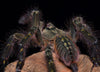
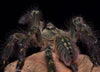
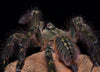
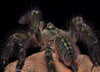
Poecilotheria rufilata (Red Slate Ornamental Tarantula)
The Red Slate Ornamental Tarantula, or Poecilotheria rufilata, is one of the largest and leggiest arboreal tarantulas in the world, rivaled in size within Poecilotheria only by P. ornata. Adults have a stunning green and yellow base that runs across the legs, carapace (head) and abdomen, with amazing undertones of other color worked into the carapace, red setae scattered over the legs and abdomen, and yellow highlights along the top of each leg. The underside is one of the most beautiful in the hobby, flashing red, purple, green and blue across its reflective parts whenever the animal is up on the glass, and the underneath of the front legs, just beneath the carapace, runs an especially vivid yellow banding of its own. Spiderlings hatch out unusually large for Poecilotheria, some close to an inch and others reaching an inch and a half, starting out gray bodied with the same base outline every young pokie starts with before a red hue begins coming in around an inch and a half to two inches and intensifies from there. P. rufilata reaches a max diagonal leg span of about 8 to 9 inches, with keepers reporting the occasional specimen pushing toward 10, and females live 12 to 15 years while males live 2 to 3. This is a fast and defensive species that would far rather bolt into its tube than stand its ground, which suits keepers who want the biggest arboreal they can get. Grab one of the largest old world arboreal tarantulas for sale today, offered here in many sizes.
Why do hobbyists keep the Red Slate Ornamental Tarantula?
- Stunning Coloration: A green and yellow base across the legs, carapace and abdomen, with red setae scattered throughout, yellow highlights along the tops of the legs, and an underside that flashes red, purple, green and blue, including a vivid yellow band underneath the front legs. There is more color on one of these than on almost anything else in the hobby. That is the iconic pokie coloration Poecilotheria is known for, and there is nothing else like it in the hobby.
- Large Arboreal Species: Poecilotheria is known for having some of the largest arboreal tarantulas in the hobby, and rufilata takes that further than the rest. At eight to nine inches, with keepers reporting the odd specimen pushing toward ten, this is debatably the largest arboreal tarantula in the world by leg span, closing in on an arboreal Theraphosa.
- Confident and Visible: With enough room, rufilata does not spend its life tucked away. It hunts actively after dark, is comfortable being out and visible during the day, and tends to be stubborn rather than skittish compared to a lot of other Asian arboreals.
- Easy To Raise: Pokies start larger and eat better than a lot of the more timid arboreal species, giving real survivability, and rufilata backs that up further, hatching out larger than most Poecilotheria and feeding with real enthusiasm, even observed taking down small lizards and other vertebrate prey in the wild. Pokies also come from a region with a wet season and a dry season, so they tolerate real-world humidity swings better than their reputation suggests, and combined with how much less defensive and flighty Poecilotheria runs compared to other Asian arboreals, that makes rufilata a solid pick even as a first Asian arboreal, not just a species to work up to.
- Uncommon in the Hobby: This is an uncommon species in the hobby, and it stays highly sought after because of it. Poecilotheria overall runs smaller egg sacs and longer gestation periods than a lot of other tarantulas, so captive-bred numbers stay limited across the board.
Which size should I choose?
- 0.75-1" Spiderling: about the size the species hatches at, your cheapest way to collect this species and watch it grow up from the very start.
- 1-1.25" Spiderling: a young spiderling tarantula, still early in its growth with plenty of size and color development still ahead.
- 1.5-2" Spiderling: already a well-started sling, past the smallest hatch-size point while still young enough to raise up yourself and watch grow.
- 2.5-3" Juvenile: past the delicate early stage with color already coming in, and still years of growth ahead.
- 3.5-4" Juvenile: past the delicate early stage with color already coming in, and still years of growth ahead.
- 4” FEMALE Juvenile: A molt-confirmed female, with real color coming in and plenty of growth still ahead. Among keepers looking for a long-term display animal, females are more sought after than males due to their longer lifespan, and on this species that means 12 to 15 years against 2 to 3 for a male.
- 7" FEMALE Adult: A full grown, molt-confirmed female, ready to be an immediate display animal for a keeper who wants certainty rather than a wait, with 12 to 15 years ahead of her against 2 to 3 for a male.
Looking for similar species?
- Browse our Old World Tarantulas and Arboreal Tarantulas collections to explore related care profiles and species groupings.
Pick the size you want above. Each size still has its own care guidance and its own price behind it, so what you see for that size is exactly what ships.
Have a question? Ask an expert!
Share information about your brand with your customers. Describe a product, make announcements, or welcome customers to your store.