



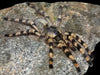

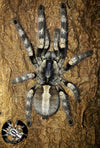
Poecilotheria formosa (Salem Ornamental Tarantula) 3”+
Pickup currently unavailable at Home Office
%203%E2%80%9D+)
✅ Covered by our 24 Hr Live Arrival Guarantee!
Description
Poecilotheria formosa (Salem Ornamental Tarantula)
The Salem Ornamental Tarantula, or Poecilotheria formosa, is a large arboreal tarantula from India, and one of the most purple animals in Poecilotheria, rivaled only by P. tigrinawesseli. Adults have an ivory base with orange setae scattered across the legs, body and abdomen, femurs with a white blush and a narrow dark purple patch, the rest of each leg banded in black and ivory with more bands than P. miranda, and a deep purple carapace (head) that runs clean without a white stripe down the middle. The underside runs plenty of white and black too, with black bands wrapping all the way around each leg for more banding than either miranda or the tiger ornamental, plus extra color that only shows when the animal rears into a defensive posture. It grows at a medium to fast pace and the purple only deepens with every molt. P. formosa reaches a max diagonal leg span of about 7 to 8 inches, and females live 12 to 15 years while males live 2 to 3. This is a fast and defensive species that would far rather bolt into its tube than stand its ground, which suits keepers who want the purple one. Grab one of the rarest old world arboreal tarantulas for sale today. By this size the pattern is already coming in and the most delicate early stretch is behind it, offered here as a juvenile.
Why do hobbyists keep the Salem Ornamental Tarantula?
- Stunning Coloration: Purple like nothing else in Poecilotheria, rivaled only by P. tigrinawesseli, with an ivory base, orange setae across the legs, body and abdomen, and black and ivory banded legs with more bands than P. miranda. Nothing else in the hobby looks quite like a grown formosa. That is the iconic pokie coloration Poecilotheria is known for, and there is nothing else like a grown formosa in the hobby.
- Large Arboreal Species: Poecilotheria is known for having some of the largest arboreal tarantulas in the hobby, and formosa does not disappoint. Adults reach seven to eight inches, impressive for a species that spends its whole life off the ground.
- Confident and Visible: Formosa hunts actively after dark, but with enough space it will not stay tucked away all day either. It tends to be stubborn and confident rather than skittish, which reads calmer than a lot of other Asian arboreals.
- Easy To Raise: Very few Asian arboreals are as forgiving as Poecilotheria is. Pokies come from a climate with an extreme wet season and an extreme dry season, and that harsh swing is a big part of why formosa is more forgiving of a new keeper's mistakes than a lot of other Asian arboreal spiderlings. It also hatches larger than most and feeds with real enthusiasm, even observed taking down small lizards and other vertebrate prey in the wild, and that combination makes it a great species once you are comfortable with Asian arboreals.
- A Collector's Pokie: One of the hardest Poecilotheria to source and breed, in part because Poecilotheria overall runs smaller egg sacs and longer gestation periods than a lot of other tarantulas, and this species sits toward the harder end even within that. This is the one serious old world keepers are still missing, not because it takes special skill, but because you rarely get the chance.
How should this Poecilotheria be kept?
- Adult Size: This species hatches at around 0.75 to 1 inch and grows toward its adult max from there. Adults reach a max diagonal leg span of about 7 to 8 inches.
- Enclosure: A 12 by 12 by 16 inch enclosure with one to two inches of substrate and a piece of cork bark set on an angle or a cork tube for it to climb into, plus a few silk or artificial plant anchors so early webbing has somewhere to start, sized ahead of the animal so it is not due for a move any time soon.
- Setup Tips: Real cork bark or driftwood pieces make a real difference for formosa, giving it natural climbing surfaces and webbing anchor points that help it settle in faster, at every size from spiderling on up.
- Rehousing: One more move to a final 16 by 16 by 24 inch enclosure as an adult, typically another twelve to sixteen months out at this growth rate.
- Temperature: Keep this species between 75 and 85 degrees Fahrenheit for its optimal range, matching the warm tropical range it comes from. Room temperature works fine too and most animals do just fine there, but it can also lead to slower growth or molting issues, so we want every keeper aware of that and matching the native range when they can, which helps the animal thrive.
- Humidity: Keep humidity high with good, ideally cross, ventilation. That combination matters far more than hitting any single humidity number.
- Water: Provide a shallow water dish placed in an elevated position if possible. This is more natural for arboreal species and helps prevent crickets from falling in and drowning. A weekly misting is suggested as well, so the animal can drink off the side of the enclosure or its own webbing if it prefers that to the dish, as long as you are wetting surfaces rather than soaking the substrate.
- Diet: Feed crickets sized around 3/4 inch, roughly the size of the carapace, at least once a week, every stage including this one.
- Temperament: Fast and defensive when it feels truly threatened, bolting into its tube rather than standing its ground. Given real space, though, Salem does not just hide: it is confident enough to be out and visible during the day as well as after dark, stubborn rather than skittish, and noticeably calmer than a lot of other Asian arboreals.
Are there any additional notes or considerations for the Salem Ornamental Tarantula?
- Medically Significant Venom: Salem Ornamental Tarantula carries medically significant venom, but it is not deadly to humans. Just something to consider before you purchase.
- Loves to Stretch Out: Like every Poecilotheria, formosa spends most of its life vertically oriented on bark, and it loves to stretch out flat with its legs in that same iconic vertical position to blend right in, whether that is on bark or any other surface in the enclosure. That is part of why generous space on all sides matters so much, not just for Poecilotheria but for Asian arboreals in general: give it room and you get to see the whole leg span and pattern stretched out at once.
- More Forgiving Than the Reputation: Every Poecilotheria comes from rugged, sometimes unforgiving parts of India and Sri Lanka, and formosa carries that same toughness into captivity. Poecilotheria tolerates real-world humidity and temperature swings better than its reputation suggests, with more margin for error day to day than most keepers expect from an old world arboreal.
Looking for similar species?
- Browse our Old World Tarantulas and Arboreal Tarantulas collections to explore related care profiles and species groupings.
Listing Notes
- This listing is for a Poecilotheria formosa Salem Ornamental juvenile measuring around three inches (3 inches) in diagonal leg span, which is the size given in the title, unsexed, with roughly a 50/50 chance of male or female. This size is past the delicate early stage with plenty of growing left, and color already showing.
- Looking for other sizes? This species is also available as a 2" Juvenile.