




Monocentropus balfouri (Socotra Island Blue Baboon Tarantula) 5.5-6“ MATURE FEMALE
Pickup currently unavailable at Home Office
%205.5-6%E2%80%9C%20MATURE%20FEMALE)
✅ Covered by our 24 Hr Live Arrival Guarantee!
Description
Monocentropus balfouri (Socotra Island Blue Baboon)
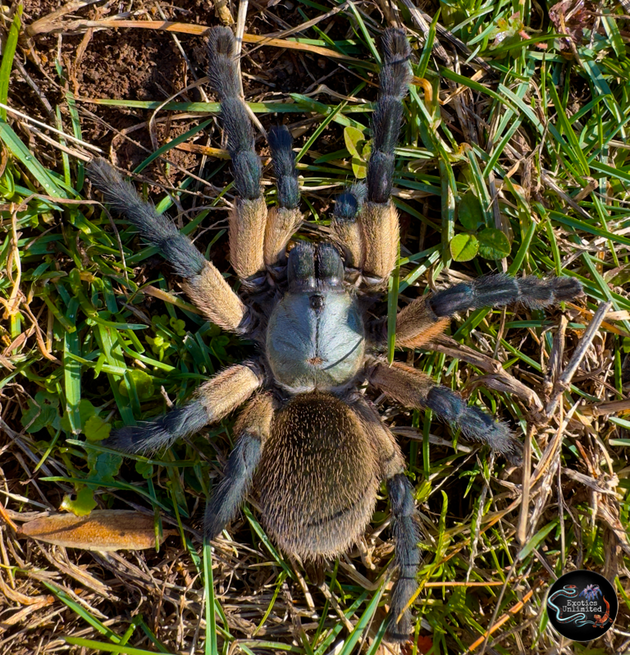
The Socotra Island Blue Baboon, or Monocentropus balfouri, is an arid terrestrial tarantula from one of the most unforgiving landscapes in the world. Adults have a striking blue coloration, with blue legs and beige femurs, a gray to blue carapace (head), and a solid beige abdomen. This blue baboon is sexually dimorphic, meaning males and females look slightly different from each other. Mature males develop solid blue legs and a solid blue carapace in their last molt of life, while females display a carapace that ranges from light gray to dark blue, depending on the individual. Spiderlings start out gray, and the blue and beige coloration comes in around 2.5 to 3 inches and intensifies with age. The max size of this species is about six inches in diagonal leg span. Monocentropus balfouri is also one of the most successfully kept communal species in the hobby, where mothers have even been observed raising their own spiderlings to adulthood in communal setups in captivity. This species has a lifespan of 10 to 15 years for females, while males only live 2 to 3. The island blue baboon has the fast, alert temperament typical of most Old World baboon tarantulas. Grab this old world tarantula for sale today, offered here as a mature female.
Why do hobbyists keep the Socotra Island Blue Baboon?
- Blue And Beige Coloration: The combination of blue legs, a gray-to-blue carapace, and a clean beige abdomen gives this species a look unlike anything else in the hobby, and it only gets more striking as adults intensify with age.
- True Communal Species: M. balfouri is one of the very small handful of tarantulas that can be kept successfully in large communal colonies. Keepers have gone as far as combining spiderlings from multiple different egg sacs into single communal setups of well over 100 individuals and successfully raising them all the way to maturity, with mothers even documented raising their own young to adulthood in captivity. This one fact is the biggest reason this species is as popular as it is.
- Sexually Dimorphic Coloration: Mature males and females finish out looking noticeably different from each other: males develop solid blue legs and a solid blue carapace, while each female keeps her own individual mix of light gray to dark blue, so no two adult females look quite the same.
- Heavy Webber: A prolific webber that builds elaborate, interconnected chamber systems, especially impressive to watch develop in a communal setup.
- Surprisingly Easy Care: Despite coming from one of the harshest arid environments in the hobby, this species is forgiving and easy to keep, making the care side approachable even though it is not a docile or beginner-temperament animal.
How should Monocentropus balfouri be kept?
- Adult Size: This species hatches at about 0.5 inch and reaches an adult max of about 6 inches in diagonal leg span.
- Enclosure: At this size, 5.5 to 6 inches in leg span, this one lives in a 18 by 18 by 12 inch enclosure (18 by 18 by 12 inches, with about 6 inches of substrate), with a piece of cork bark or a starter hide to build from. The enclosure is sized ahead of the animal on purpose, so it has room to grow and web before it needs its next size up.
- Setup Tips: Include a starter hide or a piece of cork bark to give it something to build from. M. balfouri is a heavy webber that will quickly web up the surface and dig connecting tunnels into the substrate, so give it enough loose substrate and structure to work with from the start.
- Rehousing: She is at or very near this species' full adult size, so this enclosure is her home for the long run.
- Temperature: Keep this species between 70 and 80 degrees Fahrenheit. Arid Old World terrestrials like this one hold up well across a wide range within that band, higher or lower, so there is no single number to chase.
- Humidity: This is an arid species and should not be kept wet. The one thing that matters is never letting the substrate dry out completely, and a water dish provides enough ambient moisture to keep that from happening.
- Water: A shallow textured water dish works well, something they can grip when climbing out.
- Diet: Feed a 1 1/4 to 1 1/2 inch cricket at least once a week.
- Temperament: Fast and alert, with the typical defensive attitude of most Old World baboon tarantulas.
Are there any additional notes or considerations for Monocentropus balfouri?
- At Full Adult Size: This female is at or very near this species' full adult size of about 6 inches, so what you see is close to the final result.
- Longest-Lived Option: Females of this species live 10 to 15 years, so a specimen already at this size is a long-term display animal from day one.
Listing Notes
- At or very near full adult size, our top display specimen for this species.
- Looking for other sizes? Check out all of our Socotra Island Blue Baboon tarantulas for sale to see every stage we offer, from spiderling to mature adult.