



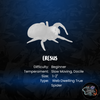
Eresus sp. 'blue Sidi Ifni' (Sidi Ifni Velvet Spider) 1/8-1/4"
Pickup currently unavailable at Home Office
%201/8-1/4%22)
✅ Covered by our 24 Hr Live Arrival Guarantee!
Description
Eresus sp. 'blue Sidi Ifni' (Sidi Ifni Velvet Spider)
The Sidi Ifni Velvet Spider, or Eresus sp. 'blue Sidi Ifni', is a terrestrial true spider native to the Sidi Ifni region, often found in bushes, grass, and among rocks. Mature males turn white and black, while females are typically black. Spiderlings hatch out solid black, and females begin showing their adult coloration around 1 inch, about half of their 1.5 to 2 inch full size, while males stay black until they mature at their own full size of about 0.75 inch. Females live around 8 years while males live only 2 to 3. This calm, low-maintenance true spider gets everything it needs from its food and asks for almost nothing beyond feeding, making it one of the easiest invertebrates in the whole hobby to keep. Grab this true spider for sale today, not a tarantula, offered here as a Spiderling.
Why do hobbyists keep the Sidi Ifni Velvet Spider?
- White And Black Coloration: Mature males turn a striking white and black, an uncommon look among true spiders, while the females are typically black velvety spiders.
- Low Maintenance Care: This species gets everything it needs from its food and asks for almost nothing beyond feeding, making it an easy true spider to keep at any experience level.
- Large Adult Size: Females reach a solid 1.5 to 2 inches at full leg span, a good size for a true spider, with males staying noticeably smaller.
- Long-Lived True Spider: Females live around 8 years, making this a long-term companion rather than a short-lived novelty.
- Alternative to Jumping Spiders: This true spider gets larger than most jumping spiders while asking for the same low-effort care, making it a natural next step for keepers who started there.
How should the Sidi Ifni Velvet Spider be kept?
- Adult Size: Hatches around 0.125 to 0.25 inch and reaches about 1.5 to 2 inches for females, 0.75 inch for males, at full leg span, so plan on upsizing the enclosure a couple of times as it grows.
- Enclosure: Spiderling housing at this 0.125 to 0.25 inch size is a 2 by 2 by 3 inch enclosure with about 0.75 inch of substrate, which is plenty, with a few sticks or twigs added for it to web on. Consider sizing up one notch for extra room.
- Rehousing: From here it has two more upsizes ahead as it grows toward its adult size, each one roughly a year or more apart at this species' unhurried pace.
- Temperature: Around 75°F is ideal, though it does fine at normal room temperature.
- Humidity: Normal room humidity is fine at this size, no extra humidity needed.
- Water: No water dish or misting needed at this size, keep the substrate dry.
- Diet: Offer prey around 1/16 inch, about a quarter of its current leg span (head), every other week while it's still small enough to be in its included vial.
- Temperament: Calm by nature, though like any true spider it can be unpredictable and should be given the same respect as any other.
Are there any additional notes or considerations for the Sidi Ifni Velvet Spider?
- Included Habitat Vial: This species ships in a small, roughly 5 gram vial lined with moss, the same housing we use for animals at this size in our own facility. It's not a complete habitat kit, just a small, effective setup, fed every other week and needing no watering while it's in there, so see Enclosure above for what to grow it into from here.
Frequently asked questions about the Sidi Ifni Velvet Spider
- Is the Sidi Ifni Velvet Spider a tarantula or a true spider? It's a true spider, not a tarantula. It belongs to Eresidae, a true spider family recognized by its velvet-textured coat, which is where the "velvet spider" name comes from.
- Do velvet spiders drink water? Yes, velvet spiders can and will drink water, which is a common misconception because we tell keepers that small ones do not need it. The catch is how it is offered. We recommend not misting the small ones, because it is very easy to overwater them, and dampness that lingers works against a small velvet spider. A dry, well-ventilated setup is the success formula.
- Why do baby velvet spiders not need water? Babies get the moisture they need from their prey, and a small enclosure is very easy to overmist. If it does not dry out quickly, that dampness works against the animal, so with the small ones we skip the mister and let their food do the work.
- How should small velvet spiders be housed? Small velvet spiders do best in smaller containers with a little ventilation, which makes it easy to check that everything dries out. As they grow and get a little larger, move them into a larger cage with more ventilation. We do not recommend putting them in a large cage until they have some size.
- Can I mist a larger velvet spider? Yes. Once a velvet spider has some size and is in a larger cage with good ventilation, you can mist it weekly. Do not let the enclosure dry out completely, and keep the airflow up so it never stays soggy. We do not recommend misting small vials.
- Can I handle my velvet spider? Velvet spiders prefer to be left in their webs, so we recommend letting them stay there. They can be picked up, but as with any animal, there is a risk of being bitten when handling them.
- Can I buy live spiders online? Yes. We ship live spiders across the US by FedEx Priority Overnight, Monday through Wednesday, with live arrival guaranteed, so you can order spiders online from our true spiders for sale and have it arrive ready to settle in.
Listing Notes
- Like all baby spiders of this genus, this freshly hatched spiderling is solid black at this stage, exactly as expected for a young Eresus spiderling of any color form.