



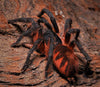


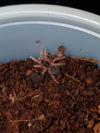
Davus sp. 'panama' (Lava Tarantula) FEMALE 1.5"
Pickup currently unavailable at Home Office
%20FEMALE%201.5%22)
✅ Covered by our 24 Hr Live Arrival Guarantee!
Description
Davus sp. 'Panama' (Lava Tarantula)
The Lava Tarantula, or Davus sp. 'Panama', is a dwarf terrestrial tarantula native to Panama. Adults display a beautiful bright red orange coloration with black legs, a black carapace (head), and black markings on the abdomen, creating a high contrast pattern that makes the whole animal look like it is glowing, which is where the lava name comes from. Spiderlings start out pink and black, and that pink brightens into a vivid red orange through the juvenile stage and keeps intensifying as the animal grows. This dwarf tarantula reaches a max diagonal leg span of about 3.5 inches, and females live about 10 years while males live 2 to 3 years. This species is calm but skittish, far more likely to run than stand its ground, and is great for keepers who want a small tarantula with serious color. Grab this dwarf new world tarantula for sale today, offered here as a juvenile female.
Why do hobbyists keep Davus sp. 'Panama'?
- Amazing Lava Coloration: A bright red orange body set against black legs, a black carapace and black markings on the abdomen, the same high-contrast pattern that gives this species its lava name. In person it reads as though the animal is lit from inside.
- Drastic Color Change: The pink and black spiderling turns red orange as it grows, and the juvenile stage is where that color runs brightest, so the change happens in front of you rather than arriving finished.
- Dwarf Species: Dwarf tarantulas suit keepers who want a small tarantula that is easier to house and less intimidating to work around, and this one gives up nothing on color for being small.
- Heavy Webber: One of the heaviest webbers we keep at this size. It will web over most of the enclosure until the setup itself becomes the display.
- Calm, But Skittish: Even-tempered day to day, but quick to react if disturbed, far more likely to walk away or duck into its webbing than to stand its ground. It moves quickly for a new world terrestrial this size, but it has no interest in a confrontation.
How should the Lava Tarantula be kept?
- Adult Size: This species reaches an adult max of about 3.5 inches in diagonal leg span. Spiderlings start out around 0.33 to 0.5 inch, so there is plenty of growing left ahead of them. A stout bodied dwarf that keeps real visual presence at a size that stays easy to house.
- Enclosure: An 8 by 8 by 5 inch enclosure with about 2 inches of substrate, a hide, and anchor points for webbing. We size every terrestrial tarantula enclosure ahead of the animal rather than to its current size, so there is room to grow into and enough depth to web heavily and scrape out a shallow burrow.
- Rehousing: One rehouse left. This one has already cleared cage 1 and sits in an 8 by 8 by 5 inch enclosure, with a 12 by 12 by 8 inch one to come at full adult size. At this species' medium to fast growth rate that last move is roughly a year out, and full size arrives in about 2 to 4 years total.
- Temperature: Keep this species between 75 and 85 degrees Fahrenheit. This is a tropical species, and keeping it at a cooler temperature raises the odds of a bad molt or a lack of appetite. We always recommend keeping all animals in their natural temperature ranges and conditions.
- Humidity: Never let the substrate dry out completely. This is a tropical species, and it is not very forgiving if things get too dry, so keep the substrate lightly moist at all times. Good ventilation is critical. Cross ventilation works best, but ample top ventilation can also be effective as long as the enclosure is not over-misted.
- Water: A shallow textured water dish works well, something they can grip when climbing out.
- Diet: Prey length should run about a quarter of the leg span, roughly the width of the carapace. At 1.5 inches that is a 3/8 inch cricket or a small roach nymph. Feed at least once a week. This species has a strong feeding response and grows steadily when kept consistently.
- Temperament: Calm but skittish, and quick to walk away or duck into its webbing when disturbed. This is not a species that stands its ground.
Are there any additional notes or considerations for the Lava Tarantula?
- Moisture Matters: Slightly moist substrate, never wet, holds humidity, drives the heavy webbing this species is known for, and keeps this tarantula out where you can see it rather than tucked away.
- Spiderling Care: Spiderlings want steady moisture, and the formula is three things: keep the substrate consistently slightly damp, feed correctly sized prey every week, and leave it alone to web. Get those right from the start and the rest takes care of itself.
- Captive Bred: All Tarantulas are 100% captive bred.
Listing Notes
- This listing is for a Davus sp. 'Panama' Lava Tarantula juvenile female measuring around 1.5 inches in diagonal leg span, which is the size given in the title, a confirmed female. The sex is already settled, so the coin flip every unsexed spiderling comes with is off the table, and on a species where the female lives about 10 years against 2 to 3 for a male that is most of what you are buying. The red orange is coming in strong at this size and it has already cleared its first enclosure, so one rehouse is done for you.
- Looking for other sizes? This species is also available as a 0.33-0.5" Spiderling, 0.5-0.75" Well-Started Spiderling, or 0.75-1" Juvenile.