



Cyriocosmus leetzi (Venezuelan Dwarf Beauty Tarantula) 0.25"
Pickup available at Home Office
Usually ready in 2-4 days
- Thrive Arrival Guarantee™ Your animal arrives thriving, or we make it right. In the small event something doesn’t go as planned during shipping, report it within 2 hours of delivery or pickup — we make it right, routinely covering the replacement animal and the shipping. See the full guarantee.
- Pick your arrival date at checkout. Choose the day that works best for your schedule.
- Safe ship promise. We verify the weather on both ends and only ship when conditions are safe.
- Free shipping over $300. Below that, $29 flat rate nationwide to a FedEx facility, or $49 flat rate direct to your address.
How big is this one?
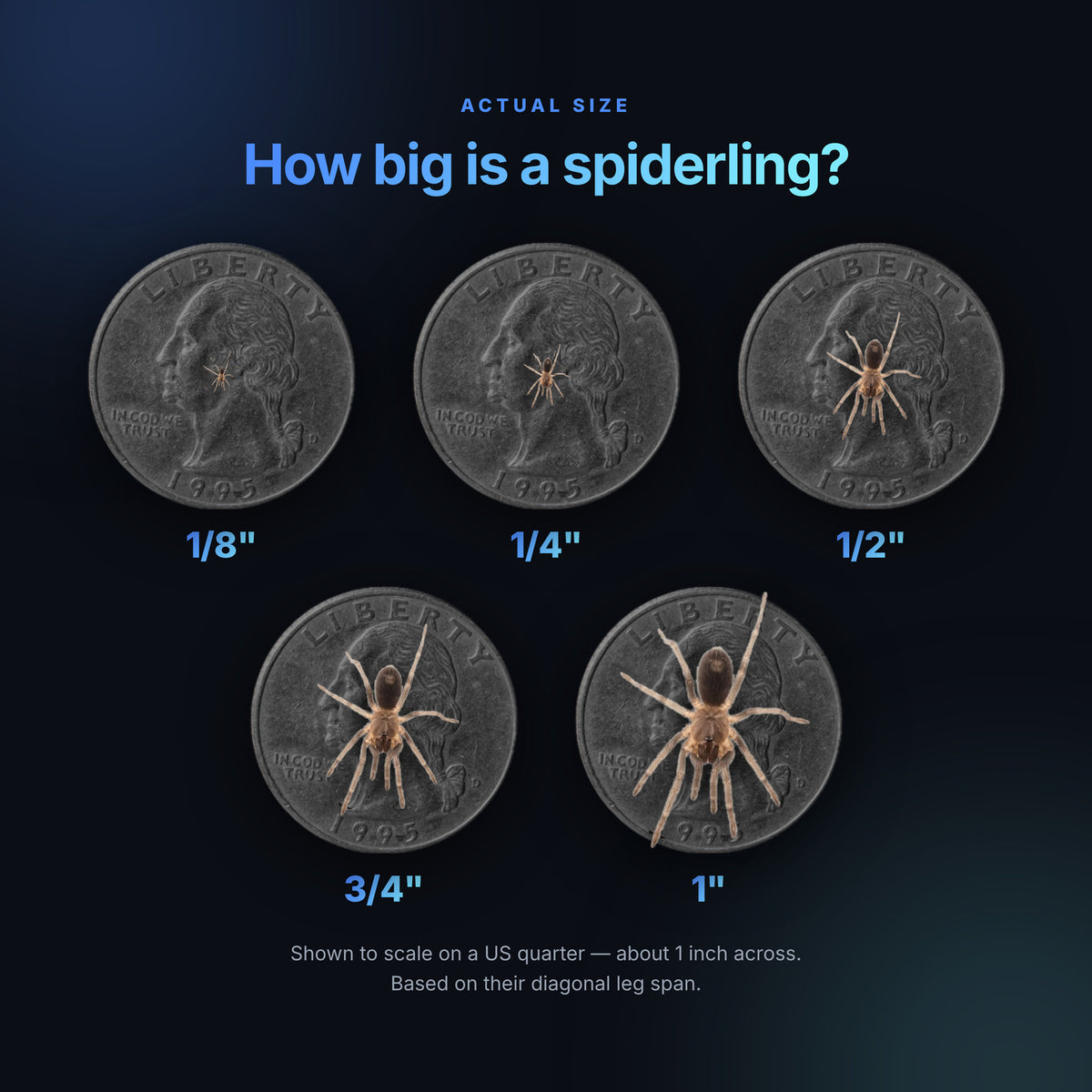
Shown to scale on a US quarter. Based on diagonal leg span.
Care overview
Quick care notes for the Venezuelan Dwarf Beauty Tarantula. Full details are in the description below.
How big does the Venezuelan Dwarf Beauty Tarantula get?
Reaches about 2 inches at full leg span.
What size enclosure does the Venezuelan Dwarf Beauty Tarantula need?
Choose an enclosure at least twice the leg span in width, depth, and height, with a hide included for security.
What temperature does the Venezuelan Dwarf Beauty Tarantula need?
Keep between 65 to 75 degrees F.
How much humidity does the Venezuelan Dwarf Beauty Tarantula need?
Keep the substrate damp but not saturated, resembling the texture and color of coffee grounds. Organic coconut fiber works well since it resists mold and holds humidity steadily.
How should I provide water for the Venezuelan Dwarf Beauty Tarantula?
A shallow textured water dish works well, something they can grip when climbing out.
What does the Venezuelan Dwarf Beauty Tarantula eat?
Crickets, roaches, or mealworms sized to about a quarter of the leg span, matching the width of the carapace (head), pre-killed if needed. Feed at least once a week.
What is the Venezuelan Dwarf Beauty Tarantula temperament like?
Docile but fast, quick to retreat rather than stand its ground.
%200.25%22)
Description
Cyriocosmus leetzi (Venezuelan Dwarf Beauty Tarantula)
One of the most beautiful true dwarf species in existence, C. leetzi squeezes a lot of beauty into a small package. This gorgeous species only gets about 2 inches and has an amazing coloration of white legs, a neat striped carapace (head), and a striped abdomen pattern. These grow very fast and are prolific, going after prey as large as themselves.
Why do hobbyists keep Cyriocosmus leetzi?
- Stunning Coloration: White legs paired with a neatly striped carapace and abdomen.
- Fast Grower: Grows very fast for a dwarf species.
- Great Feeding Response: Prolific eaters that will take on prey as large as themselves.
How should Cyriocosmus leetzi be kept?
- Adult Size: Reaches about 2 inches at full leg span.
- Enclosure: Choose an enclosure at least twice the leg span in width, depth, and height, with a hide included for security.
- Temperature: Keep between 65 to 75 degrees F.
- Humidity: Keep the substrate damp but not saturated, resembling the texture and color of coffee grounds. Organic coconut fiber works well since it resists mold and holds humidity steadily.
- Water: A shallow textured water dish works well, something they can grip when climbing out.
- Diet: Crickets, roaches, or mealworms sized to about a quarter of the leg span, matching the width of the carapace (head), pre-killed if needed. Feed at least once a week.
- Temperament: Docile but fast, quick to retreat rather than stand its ground.
Are there any additional notes or considerations?
- Feed With Caution: Pre-killing crickets before feeding is recommended given this species' small size relative to typical prey.
- Captive Bred: All Tarantulas are 100% captive bred.
More than a live arrival guarantee
Thrive Arrival Guarantee™
Here's what that means.
Free replacement and reshipping
In the small chance your animal doesn't make it, report it within 2 hours of getting your box
Handpicked and health-checked
If one doesn't look right, it doesn't ship
Temperature-controlled packaging
Every box insulated. Heat or cool packs included as needed
Lifetime health and care support
Ask us anything, for as long as you keep it
How we source
100% captive bred tarantulas
Never wild caught.
Never wild-caught tarantulas
No animals taken from the wild for profit
Many bred in house
Our own breeding projects, raised here
Many sourced from US breeders
Domestic breeders we know and buy from directly
Vote with your dollar
Support captive bred and the hobby stops taking from the wild
Wild-caught animals cost less to acquire and carry far more margin, which is the whole reason many sellers list them. Here is the tell: a wild-caught adult Curly Hair costs about the same as a captive-bred spiderling. An adult cannot cost the same as a baby unless something was skipped, and what was skipped is the years of breeding, feeding and care.
Goliath Bird Eaters, Costa Rican Stripe Knees, Curly Hairs and Arizona Blondes all have established captive breeding populations, so there is no reason to take them from the wild at all. If we stop supporting cheap wild-caught adults, more get bred, and they get cheaper. In the rare cases we handle wild-collected animals, such as some centipedes and whip scorpions, the goal is to get them into breeding projects in the hobby.
Straight answers
Venezuelan Dwarf Beauty Tarantula FAQ: price, size, safety and shipping
What keepers ask before buying a Venezuelan Dwarf Beauty Tarantula, answered the way we would at a show table.
Buying and price
Where can I buy the Venezuelan Dwarf Beauty Tarantula?
Right here. We ship captive bred Cyriocosmus leetzi (Venezuelan Dwarf Beauty Tarantula) tarantulas for sale to keepers across the US by FedEx Overnight, and you pick your arrival date at checkout. This 0.25" sling is in stock now.
We have been shipping live tarantulas since 2019 and ship Monday, Tuesday and Wednesday.
How much does the Venezuelan Dwarf Beauty Tarantula cost?
This 0.25" Venezuelan Dwarf Beauty Tarantula is $39.00. A sling is the lowest cost way to start the species, and it lets you raise the animal from the beginning.
Pet invertebrate orders over $300 ship free to a FedEx facility, and email subscribers get 10% off invertebrates. Compare sizes and prices across all tarantulas for sale.
Is the Venezuelan Dwarf Beauty Tarantula captive bred?
Yes. Every tarantula we sell is 100% captive bred and never wild caught. Many are bred here in house, and many come from US breeders we buy from directly.
Size and life stage
Is the Venezuelan Dwarf Beauty Tarantula sling hard to keep?
Slings are the most fragile stage, so they need a little more attention than an adult. Use a small enclosure sized to the animal, keep the substrate damp but never saturated and never fully dry, offer pinhead to small prey, and leave it alone as much as you can. They grow fast, so plan to rehouse into a bigger enclosure as it molts.
The upside is that a sling is the cheapest way to start the species and you get to watch it grow up.
How long does the Venezuelan Dwarf Beauty Tarantula live?
New World females commonly live 10 to 30 years, and males live much shorter lives.
That makes the Venezuelan Dwarf Beauty Tarantula a long term pet. Adult size is in the care overview and the description.
Pets and safety
Is the Venezuelan Dwarf Beauty Tarantula a good pet or beginner tarantula?
It can be a good pet tarantula for the right keeper. We tag it Docile on the listing. Temperament is not the same as difficulty, so we flag true first-timer species separately.
Browse our beginner tarantulas to see the species we recommend for a first tarantula.
Will the Venezuelan Dwarf Beauty Tarantula bite me, and is it dangerous?
A bite is unlikely if you are not handling the animal, and we do not recommend handling. We also will not tell you tarantulas are harmless, because that is not true.
The Venezuelan Dwarf Beauty Tarantula is a New World species. Its venom is mild to moderate, and the real nuisance for most keepers is its urticating hairs, which can irritate skin and eyes.
Can a tarantula escape its enclosure?
Not from a properly closed enclosure, but the honest answer is that tarantulas are better at this than people expect. They can fit through any gap their carapace fits through, push a loose lid, and chew through thin mesh. Anyone who tells you a tarantula cannot climb is wrong.
Use an enclosure with a lid that latches and vent holes narrower than the animal's carapace and you will never have a problem.
What if my partner or parents are not sure about a tarantula?
It is the most common reason a keeper never starts, so it is worth answering plainly. A tarantula makes no noise and no smell, it lives in a container smaller than a shoebox, it eats a few times a month, and nobody else in the house ever has to look at it, feed it or touch it.
If there is a genuine phobia involved, that deserves respect rather than an argument. A small enclosure in a room they do not use is a reasonable place to start.
Can I hold a tarantula?
We would rather tell you now than sell you the wrong animal: no species really wants to be handled. Most experienced keepers never do it, and the risk is mostly to the spider, which is fragile and can be badly hurt by a short fall.
These are animals to watch rather than handle, and the good news is that the interesting ones are visible far more than people expect.
Shipping and guarantee
Can I buy the Venezuelan Dwarf Beauty Tarantula online, and how is it shipped?
Yes. We ship every live tarantula by FedEx Overnight on Monday, Tuesday and Wednesday, and you choose your arrival date at checkout. We check the weather on both ends and hold the box if it is not safe.
Shipping to a FedEx facility for pickup is $29 flat, and it is free on pet invertebrate orders over $300. Home delivery is $49. Every box that needs one includes a heat or cold pack. See the shipping policy or our FAQ page for the full details.
How does the Thrive Arrival Guarantee work?
The Thrive Arrival Guarantee™ means we guarantee your animal arrives thriving, not just alive. An animal that shows up alive but in trouble is not a good arrival, and we do not treat it like one.
Open the box the day it arrives and check the animal. Report a problem within 2 hours of delivery and we reship. Report it within 24 hours and we replace it on your next order. You are still covered, the replacement just travels with your next shipment. We review every case individually.
Getting started
Why is my tarantula on its back? Is it dead?
Almost certainly not. It is moulting. Tarantulas shed on their backs, and it looks exactly like death to someone seeing it for the first time.
Do not touch it, move it, or try to help. Disturbing a moulting tarantula is one of the few things that genuinely kills them. Wait it out, and do not offer food for at least a week and a half afterwards while the new fangs harden.
My tarantula has not eaten in a month. Should I worry?
No. It is close to impossible to starve a healthy tarantula. A month is nothing, six-month fasts are routine, and much longer ones are documented. A refused meal usually means a moult is coming. Keep the water dish full and leave it be.
What do I need ready before my tarantula arrives?
An enclosure sized to the animal, substrate deep enough for its care type, a hide, a shallow water dish, and feeders. Set the enclosure up before the animal arrives so it can go straight in rather than waiting in its shipping vial.
Your discount doesn't expire. It grows.
10% off, forever
Subscribe to our free email list and earn 10% off all invertebrates, plus special discounts during events.
It builds as you return
Your discount grows as you come back, instead of resetting.
Stacks with free shipping
Free shipping on orders over $300, and rewards stack on top of it.
Discount stays active as long as you stay subscribed.
Everything this animal needs on day one
Enclosure, substrate and supplies, set it up before the animal arrives so it can go straight in.
Enclosure, substrate and supplies, set it up before the animal arrives so it can go straight in.


