

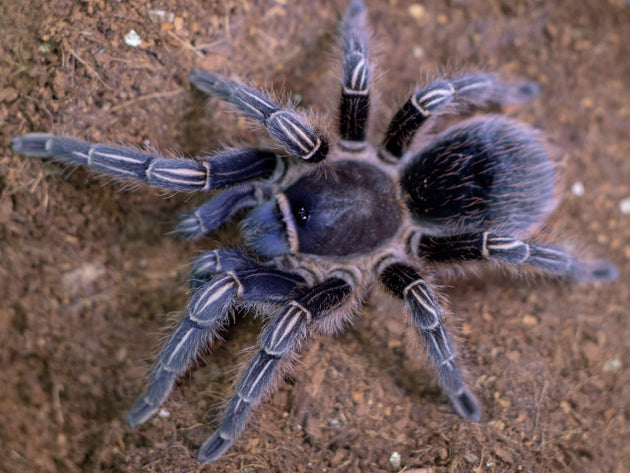


Aphonopelma seemanni (Costa Rican Zebra, Stripe Knee Tarantula) 1-1.25"
Pickup currently unavailable at Home Office
- Thrive Arrival Guarantee™ Your animal arrives thriving, or we make it right. In the small event something doesn’t go as planned during shipping, report it within 2 hours of delivery or pickup — we make it right, routinely covering the replacement animal and the shipping. See the full guarantee.
- Pick your arrival date at checkout. Choose the day that works best for your schedule.
- Safe ship promise. We verify the weather on both ends and only ship when conditions are safe.
- Free shipping over $300. Below that, $29 flat rate nationwide to a FedEx facility, or $49 flat rate direct to your address.

Description
Aphonopelma seemanni (Costa Rican Stripe Knee Tarantula) 1-1.25"
The Costa Rican Stripe Knee Tarantula, or Aphonopelma seemanni, is a tropical tarantula from Costa Rica. Adults of this species have a gray body with bold striped, banded knees that give the species its name. The striped knee pattern is visible from an early age, and we have noticed individuals often show a bluish tint right after a fresh molt that settles back into gray within a few days, while the species only grows to about 6 inches in diagonal leg span. Like others in the genus, along with Brachypelma, this species lives a long time, with females living 20 to 30 years while males live 3 to 5 years. This species is also very calm and forgiving, and one we recommend for beginner keepers or anyone who wants an easier keeping experience. Grab this docile new world tarantula for sale today, offered here as a juvenile.
Why do hobbyists keep Aphonopelma seemanni?
- Striped Knee Coloration: This species has a gray body with bold, striped, banded knees that give it its name.
- Docile Temperament: This species is slow moving and very deliberate, not particularly skittish, and docile on top of that.
- Great Beginner Species: A calm temperament and forgiving care needs make this one of the easiest Aphonopelma for a first-time keeper.
- Great Display Species: This species stays out in the open on the surface rather than staying hidden below ground, so there is usually something to see.
- Captive Bred, Not Wild: This is one of the most commonly wild-caught tarantulas in the US hobby, since imported specimens are cheap and plentiful. Every one of ours is captive bred instead. There is no ecological need to collect from the wild when captive-bred slings hatch out every year, and buying captive bred supports breeders rather than pulling animals out of their native habitat. If you ever see a full grown adult of this species selling for unusually little, that price alone is often a sign it was wild collected rather than captive bred.
How should Aphonopelma seemanni be kept?
- Adult Size: Spiderlings start out around 0.5 inch, and adults reach about 6 inches in diagonal leg span, so plan on upsizing the enclosure as it grows.
- Enclosure: A 6x6x4" enclosure with 2" of substrate works well at this size. Good ventilation is critical. Cross ventilation works best, but ample top ventilation can also be effective as long as the enclosure is not over-misted.
- Rehousing: From here, plan on two more upsizes: a 12x12x8" enclosure with 4" of substrate, then a final 18x18x12" enclosure with 6" of substrate. At this species' growth rate, 4 to 6 years to reach adult size, each cage typically lasts around 18 to 24 months before the next upsize.
- Temperature: Keep this species between 65 and 75°F, in line with the tropical range it comes from. Typical indoor room temperature works well without any extra heating.
- Humidity: Water it and let it dry rather than keeping it damp. Aim for substrate that dries out within about a day after you add moisture, and never let it sit soaking.
- Water: A shallow textured water dish works well, something they can grip when climbing out.
- Diet: Offer prey around 5/16" at this size, roughly the width of the carapace (head). Feed at least once a week.
- Temperament: Docile and unlikely to act defensively, more likely to retreat than stand its ground when startled.
Are there any additional notes or considerations?
- Captive Bred: All tarantulas at Exotics Unlimited are captive bred.
- Also Known As: This species is sometimes sold as the Costa Rican Zebra Tarantula. We use Costa Rican Stripe Knee Tarantula as our primary name for it here.
Listing Notes
- This listing is for an Aphonopelma seemanni Costa Rican Stripe Knee Tarantula juvenile measuring around 1 to 1.25 inches in diagonal leg span, with the striped knee pattern clearly visible.
- Looking for this species in another size? Check out the 0.50" Spiderling, 0.75-1" Yearling.
More than a live arrival guarantee
Thrive Arrival Guarantee™
Here's what that means.
Free replacement and reshipping
In the small chance your animal doesn't make it, report it within 2 hours of getting your box
Handpicked and health-checked
If one doesn't look right, it doesn't ship
Temperature-controlled packaging
Every box insulated. Heat or cool packs included as needed
Lifetime health and care support
Ask us anything, for as long as you keep it
How we source
100% captive bred tarantulas
Never wild caught.
Never wild-caught tarantulas
No animals taken from the wild for profit
Many bred in house
Our own breeding projects, raised here
Sourced from US breeders
Domestic breeders we know and buy from directly
Vote with your dollar
Support captive bred and the hobby stops taking from the wild
Wild-caught animals cost less to acquire and carry far more margin, which is the whole reason many sellers list them. Here is the tell: a wild-caught adult Curly Hair costs about the same as a captive-bred spiderling. An adult cannot cost the same as a baby unless something was skipped, and what was skipped is the years of breeding, feeding and care.
Goliath Bird Eaters, Costa Rican Stripe Knees, Curly Hairs and Arizona Blondes all have established captive breeding populations, so there is no reason to take them from the wild at all. If we stop supporting cheap wild-caught adults, more get bred, and they get cheaper. In the rare cases we handle wild-collected animals, such as some centipedes and whip scorpions, the goal is to get them into breeding projects in the hobby.
Straight answers
The questions keepers actually ask
Taken from what new keepers post on the forums, in their words, not ours.
Will I kill it?
This is the most common worry new keepers have, and the honest answer is reassuring: a tarantula is far more likely to die from being fussed over than from being left alone. The three things that actually matter are a water dish you keep full, substrate deep enough to burrow in, and leaving the animal alone when it seals itself away.
Almost everything else, including misting schedules, humidity gauges and supplemental heat, causes more deaths than it prevents.
My tarantula is on its back. Is it dead?
Almost certainly not. It is moulting. Tarantulas shed on their backs, and it looks exactly like death to someone seeing it for the first time.
Do not touch it, move it, or try to help. Disturbing a moulting tarantula is one of the few things that genuinely kills them. Wait it out, and do not offer food for at least a week and a half afterwards while the new fangs harden.
It has not eaten in a month. Should I worry?
No. It is close to impossible to starve a healthy tarantula. A month is nothing, six-month fasts are routine, and much longer ones are documented. A refused meal usually means a moult is coming. Keep the water dish full and leave it be.
How does the Thrive Arrival Guarantee work?
Open the box the day it arrives and check the animal. In the small chance something does not go as planned during shipping, report it as soon as possible with a photo or video, and we will make it right, often covering the replacement animal including shipping.
We ship FedEx Overnight, we check the weather on both ends before the box leaves, and we would rather hold an order than gamble with it.
Can it escape?
Not from a properly closed enclosure, but the honest answer is that tarantulas are better at this than people expect. They can fit through any gap their carapace fits through, push a loose lid, and chew through thin mesh. Anyone who tells you a tarantula cannot climb is wrong.
Use an enclosure with a lid that latches and vent holes narrower than the animal's carapace and you will never have a problem.
Will it bite me, and how bad is it?
A bite is unlikely if you are not handling the animal, and we do not recommend handling. We will also not tell you tarantulas are completely harmless, because that is not true.
New World species have urticating hairs that can irritate skin and eyes, which is the real nuisance for most keepers. Old World species have no hairs, stronger venom, and a bite that can mean serious pain and cramping. We label which is which on every listing.
My partner or parents are not sure about this.
It is the most common reason a keeper never starts, so it is worth answering plainly. A tarantula makes no noise and no smell, it lives in a container smaller than a shoebox, it eats a few times a month, and nobody else in the house ever has to look at it, feed it or touch it.
If there is a genuine phobia involved, that deserves respect rather than an argument. A small enclosure in a room they do not use is a reasonable place to start.
Can I hold it?
We would rather tell you now than sell you the wrong animal: no species really wants to be handled. Most experienced keepers never do it, and the risk is mostly to the spider, which is fragile and can be badly hurt by a short fall.
These are animals to watch rather than handle, and the good news is that the interesting ones are visible far more than people expect.
What do I need to have ready before it arrives?
An enclosure sized to the animal, substrate deep enough for its care type, a hide, a shallow water dish, and feeders. Set the enclosure up before the animal arrives so it can go straight in rather than waiting in its shipping vial.
Your discount doesn't expire. It grows.
10% off, forever
Subscribe to our free email list and earn 10% off all invertebrates, plus special discounts during events.
It builds as you return
Your discount grows as you come back, instead of resetting.
Stacks with free shipping
Free shipping on orders over $300, and rewards stack on top of it.
Discount stays active as long as you stay subscribed.
Everything this animal needs on day one
Enclosure, substrate and supplies, set it up before the animal arrives so it can go straight in.
Enclosure, substrate and supplies, set it up before the animal arrives so it can go straight in.


